 By Patricia Jones
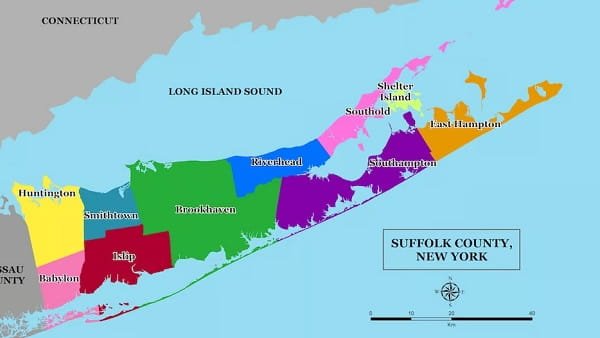
 Suffolk County occupies the eastern two-thirds of Long Island and is one of the most populous counties in New York State. It extends from the Nassau County boundary through large suburban communities, research and industrial centres, agricultural districts, fishing ports, resort villages and the eastern forks that end at Montauk Point and Orient Point.
Riverhead is the county seat and remains an important centre for courts, records and county services. Hauppauge is the principal administrative centre, containing the H. Lee Dennison Building and many executive, legislative and departmental offices. Central Islip is another major government and judicial location because it contains the John P. Cohalan Jr. Court Complex.
The county combines a large commuter-based suburban economy with nationally recognised research institutions, healthcare systems, tourism, farming, vineyards, fisheries and maritime activity. Its main long-term challenges include housing affordability, traffic congestion, drinking-water protection, wastewater management, coastal flooding and the preservation of open space.
Quick Overview of Suffolk County
| Category | Details |
| State | New York |
| Region | Eastern Long Island, New York metropolitan area |
| County seat | Riverhead |
| Main administrative centre | Hauppauge |
| Established | 1683 |
| Estimated population | 1,546,090 in 2025 |
| Land area | Approximately 911.17 square miles |
| Towns | 10 |
| Governing structure | County Executive and 18-member County Legislature |
| County Executive | Edward P. Romaine |
| Legislature presiding officer | Anthony A. Piccirillo |
| Deputy presiding officer | James F. Mazzarella |
| County clerk | Vincent Puleo |
| County comptroller | John M. Kennedy Jr. |
| District attorney | Raymond A. Tierney |
| Sheriff | Dr. Errol D. Toulon Jr. |
| Police commissioner | Kevin Catalina |
| County attorney | Christopher J. Clayton |
| Judicial district | New York State Tenth Judicial District |
| District administrative judge | Justice Andrew A. Crecca |
| Supreme Court supervising judge | Justice Thomas F. Whelan |
| County Court supervising judge | Justice Richard Ambro |
| District Court supervising judge | Judge Karen Kerr |
| Family Court supervising judge | Judge Caren Loguercio |
| Major airport | Long Island MacArthur Airport in the Town of Islip |
| County-owned airport | Francis S. Gabreski Airport |
| Major economic sectors | Healthcare, research, professional services, retail, construction, tourism, manufacturing, agriculture and fisheries |
The U.S. Census Bureau estimated Suffolk County’s population at 1,546,090 in July 2025. This was approximately 1.3% above the April 2020 population estimates base. The county had an estimated 583,777 housing units in 2025.
Location and Geographic Structure
Suffolk County begins at the Nassau County line and stretches eastward to the Atlantic Ocean. Long Island Sound forms most of its northern boundary, while the Atlantic Ocean and a chain of barrier beaches lie to the south. At the eastern end, the island divides into the North Fork and South Fork around the Peconic Bays.
The county covers about 911.17 square miles of land, but its overall geographic reach is much larger when bays, harbours and coastal waters are considered. Its landscape includes densely developed suburbs in the west, pine barrens and river corridors in the centre, and farmland, vineyards, beaches and maritime communities in the east.
Important geographic features include:
- Long Island Sound
- Great South Bay
- Peconic Bay and Gardiners Bay
- Fire Island and the Atlantic barrier beaches
- Montauk Point
- Orient Point and the North Fork
- The South Fork and the Hamptons
- The Long Island Central Pine Barrens
- Carmans River and Peconic River
- Smith Point, Cupsogue and Shinnecock inlets
Interstate 495, commonly called the Long Island Expressway, is the principal east-west highway through central Suffolk. New York State Route 27, including Sunrise Highway and Montauk Highway, serves the southern part of the county. Routes 25 and 25A provide important northern and east-west connections.
Other major roads include the Sagtikos State Parkway, Sunken Meadow State Parkway, Robert Moses Causeway, Nicolls Road, William Floyd Parkway and Veterans Memorial Highway. Road traffic is heavily affected by the island’s linear geography because most long-distance travel must move east or west through a limited number of corridors.
Towns, Villages and Communities
Suffolk County contains ten towns:
- Babylon
- Brookhaven
- East Hampton
- Huntington
- Islip
- Riverhead
- Shelter Island
- Smithtown
- Southampton
- Southold
These towns contain more than 30 incorporated villages and a much larger number of unincorporated hamlets. Important population and employment centres include Huntington, Babylon, Deer Park, Brentwood, Central Islip, Hauppauge, Smithtown, Ronkonkoma, Stony Brook, Port Jefferson, Patchogue, Shirley, Mastic, Riverhead and the communities of the East End.
Well-known incorporated villages include Amityville, Babylon, Brightwaters, Greenport, Head of the Harbor, Huntington Bay, Islandia, Lake Grove, Lindenhurst, Lloyd Harbor, Northport, Ocean Beach, Patchogue, Port Jefferson, Sag Harbor, Southampton, Westhampton Beach and East Hampton. Fire Island also contains small village and hamlet communities whose access and public services differ from mainland Suffolk.
Town and village governments perform many services that residents elsewhere may expect from a county. These include local planning, building permits, zoning, parks, waste collection, street maintenance and, in several areas, policing. The exact authority depends on whether a property is inside an incorporated village and which special districts serve it.
Suffolk County also contains the Shinnecock Indian Nation and the Poospatuck Reservation of the Unkechaug Indian Nation. Their governments exercise authority over their own lands and should not be treated as ordinary town or hamlet administrations.
Population and Housing
Suffolk County’s population increased modestly between 2020 and 2025. The western and central portions remain heavily suburban, while the East End has a lower year-round population but a much larger seasonal population during summer and holiday periods.
Important population, housing and income indicators for 2020-2024 include:
- Owner-occupied housing rate: 82.2%
- Median owner-occupied home value: $578,400
- Median gross monthly rent: $2,255
- Median monthly owner cost with a mortgage: $3,320
- Households: 512,565
- Average household size: 2.93 people
- Median household income: $130,686
- Per-capita income: $57,164
- Residents below the poverty line: 6.7%
- Average journey to work: 31.1 minutes
- Adults with a bachelor’s degree or higher: 40.2%
Approximately 19.8% of residents are under 18, while 20.1% are aged 65 or older. Hispanic or Latino residents represent about 24.5% of the population. The county also has substantial Black, Asian, immigrant and multilingual communities, particularly in its western and central towns.
Housing ranges from dense village neighbourhoods and suburban subdivisions to apartments, waterfront homes, agricultural properties, seasonal houses and large estates. Limited land, strong demand, high construction costs and environmental restrictions contribute to high purchase prices and rents.
Economy and Employment
Suffolk County has one of the largest county economies in New York. It recorded 50,748 employer establishments and 592,580 jobs in 2023, with annual payroll of approximately $39.33 billion. Retail sales reached about $36.86 billion in 2022, while healthcare and social-assistance organisations generated roughly $17.45 billion in receipts or revenue.
Major economic sectors include:
- Healthcare and social assistance
- Scientific research and higher education
- Professional and business services
- Retail and consumer services
- Construction and real estate
- Manufacturing, technology and defence-related activity
- Tourism, hotels, restaurants and recreation
- Agriculture, vineyards and food production
- Commercial fishing and aquaculture
- Transportation, warehousing and aviation
- Government and public education
Stony Brook University and Stony Brook Medicine are major employers and research institutions. Brookhaven National Laboratory in Upton supports scientific research, technology development and specialised employment. Cold Spring Harbor Laboratory, healthcare systems, community colleges and private technology companies add to the county’s knowledge-based economy.
The Hauppauge Industrial Park and other business districts support manufacturing, distribution, engineering, professional services and technology firms. Long Island MacArthur Airport, Francis S. Gabreski Airport, railway freight connections and major highways assist regional business activity.
Agriculture remains a defining part of the East End. Suffolk is known for vegetables, nursery products, vineyards, wineries, orchards and farm-based tourism. Commercial fishing, shellfish cultivation and marine trades remain important around Montauk, Greenport, Shinnecock, the Great South Bay and the Peconic estuary.
County Administration and Government
Suffolk County operates under a charter government with an elected County Executive and an 18-member County Legislature. Each legislator represents a geographic district and normally serves a two-year term. The Legislature is a separate branch of county government and adopts local laws, budgets, capital plans and major financial authorisations.
The Legislature is responsible for:
- Adopting the operating, capital and community-college budgets
- Enacting local laws and setting county policy
- Authorising borrowing and major contracts
- Reviewing executive appointments where confirmation is required
- Establishing certain county fees
- Conducting committee hearings and legislative oversight
- Approving land acquisitions and major infrastructure projects
Anthony A. Piccirillo serves as Presiding Officer of the Legislature for 2026, while James F. Mazzarella serves as Deputy Presiding Officer. The Legislature maintains offices in Hauppauge and Riverhead and conducts public meetings through its committee and general-session system.
The county’s 2026 operating budget is approximately $4.3 billion. Major spending areas include public safety, health and social services, employee costs, transportation, environmental programmes, community-college support and debt service.
County Executive and Administrative Leadership
Edward P. Romaine serves as Suffolk County Executive. He was elected in November 2023 and took office on January 1, 2024. The County Executive is the elected head of the executive branch and is responsible for implementing county laws, preparing the proposed budget and directing departments under executive authority.
Suffolk County does not use the county-manager system found in some other states. The County Executive performs the central executive and administrative role, supported by deputy county executives, commissioners, department heads, budget staff and the County Attorney.
Major executive responsibilities include:
- Preparing the recommended operating and capital budgets
- Appointing commissioners and senior administrators
- Managing executive departments and county facilities
- Signing or vetoing legislation
- Coordinating public safety and emergency response
- Implementing infrastructure and environmental programmes
- Representing the county before state and federal agencies
- Monitoring service delivery and organisational performance
The main executive offices are located in the H. Lee Dennison Building in Hauppauge, with additional operations at the Riverhead County Center and other county complexes. Independently elected offices such as the Sheriff, District Attorney, Clerk and Comptroller exercise authority granted separately by law.
Other Important County Officials
Current countywide and senior appointed officials include:
- County clerk: Vincent Puleo
- County comptroller: John M. Kennedy Jr.
- District attorney: Raymond A. Tierney
- Sheriff: Errol D. Toulon Jr.
- Police commissioner: Kevin Catalina
- County attorney: Christopher J. Clayton
County Clerk Vincent Puleo maintains land records, mortgages, liens, judgments and numerous court-related records. The Clerk’s principal office is at the Riverhead County Center.
Comptroller John M. Kennedy Jr. serves as the county’s chief fiscal officer. The Comptroller audits county spending, processes financial obligations, manages specified tax and trust functions and prepares or oversees county financial reporting.
District Attorney Raymond A. Tierney leads criminal prosecutions for offences handled at the county level. Sheriff Errol D. Toulon Jr. manages correctional facilities, court security, civil enforcement, warrants and other law-enforcement functions. Police Commissioner Kevin Catalina leads the Suffolk County Police Department.
County Attorney Christopher J. Clayton is the chief civil legal adviser to county government. His office represents the county, its departments and covered officials in civil proceedings and advises the executive and legislative branches on governmental legal matters.
Judiciary and Court System
Suffolk County forms New York State’s Tenth Judicial District. The courts are part of the New York State Unified Court System rather than a department controlled by the County Executive or Legislature. Justice Andrew A. Crecca serves as District Administrative Judge and oversees court operations throughout the county.
Current senior judicial leaders include:
- District administrative judge: Justice Andrew A. Crecca
- Supreme Court supervising judge: Justice Thomas F. Whelan
- County Court supervising judge: Justice Richard Ambro
- District Court supervising judge: Judge Karen Kerr
- Family Court supervising judge: Judge Caren Loguercio
Major court facilities are located in Riverhead and Central Islip. The Arthur M. Cromarty Court Complex in Riverhead contains County Court, Supreme Court and related operations. The John P. Cohalan Jr. Court Complex in Central Islip contains District Court, Family Court and Supreme Court functions.
The principal courts handle the following matters:
- Supreme Court: major civil cases, matrimonial matters and other proceedings within its broad constitutional jurisdiction
- County Court: felony criminal cases and certain appeals and specialised proceedings
- District Court: misdemeanours, preliminary felony proceedings, landlord-tenant matters, small claims and qualifying civil cases in the five western towns
- Family Court: child custody, support, neglect, juvenile and family-offence proceedings
- Surrogate’s Court: estates, wills, probate, guardianships and adoptions
- Town and village justice courts: traffic offences, local-code cases, misdemeanours and preliminary proceedings within their jurisdictions
The Suffolk County Clerk acts as clerk for Supreme Court and maintains many court records, while the state court system manages judges, court administration and courtroom operations.
Public Safety and Emergency Services
Public safety responsibility in Suffolk County is divided among county, town, village, state and federal agencies. The Suffolk County Police Department serves the county police district, which covers the five western towns of Babylon, Brookhaven, Huntington, Islip and Smithtown, although some incorporated villages maintain their own police departments.
The East End towns of Riverhead, Southampton, East Hampton, Southold and Shelter Island operate town police departments. Village departments, New York State Police, park police and other specialised agencies also have jurisdiction in particular locations.
The Suffolk County Police Department provides:
- Precinct patrol and emergency response
- Criminal investigations
- Highway and traffic enforcement
- Crime analysis and intelligence support
- Marine, aviation and specialised-unit operations
- Emergency communications and countywide assistance
The Sheriff’s Office operates county correctional facilities, supplies court security, serves civil documents and warrants, conducts enforcement operations and supports roadway safety programmes. The District Attorney directs criminal prosecution, while Probation supervises eligible offenders and provides court-related services.
Fire protection and emergency medical service are delivered mainly through local fire districts, municipal departments and volunteer organisations. The county Department of Fire, Rescue and Emergency Services coordinates communications, training, hazardous-material response, emergency management and inter-agency support.
Transportation and Infrastructure
The Long Island Rail Road is the county’s principal regional passenger railway. The Ronkonkoma Branch, Port Jefferson Branch and Montauk Branch connect Suffolk communities with Nassau County, Queens and New York City. The eastern railway network also reaches Greenport and Montauk, although service frequency varies significantly by location and time of day.
Suffolk County Transit operates 26 fixed bus routes and two on-demand service zones, with service throughout the year. Bus routes connect residential areas with railway stations, schools, shopping districts, hospitals, government centres and employment areas.
Long Island MacArthur Airport in Ronkonkoma is owned and operated by the Town of Islip and provides scheduled passenger service. Francis S. Gabreski Airport in Westhampton Beach is county-owned and supports general aviation, business activity and military operations. Smaller public and private aviation facilities serve other parts of the county.
Ferry services provide important off-island and cross-sound connections. Routes operate between Port Jefferson and Bridgeport, and between Orient Point and New London. Local ferries also connect Shelter Island with the North and South forks, while passenger ferries serve Fire Island communities.
County Public Works manages county roads, bridges, buildings, drainage, wastewater facilities and capital construction. State highways are maintained by New York State, while towns, villages and special districts control many local roads and public facilities.
Water, Wastewater and Environmental Services
Drinking water comes primarily from underground aquifers. The Suffolk County Water Authority is a separate public-benefit corporation rather than a county department, although it supplies water to much of the county. Private wells continue to serve some properties.
Wastewater management is one of Suffolk’s most important public-policy issues. Large areas rely on individual septic systems and cesspools rather than central sewers. Excess nitrogen can damage groundwater, bays, wetlands and coastal ecosystems. County Health Services regulates many onsite systems, while county and local sewer districts operate treatment infrastructure in selected areas.
The county maintains extensive parkland and open space, including beaches, campgrounds, forests, golf courses, historic properties and nature preserves. Major county parks include Smith Point, Cupsogue Beach, Indian Island, Cathedral Pines, Blydenburgh, Southaven and Meschutt Beach.
Environmental programmes address drinking-water quality, shellfish restoration, farmland preservation, coastal resilience, wetlands, vector control, solid-waste planning and protection of the Central Pine Barrens. Residents should check beach advisories, storm alerts and seasonal rules before visiting coastal facilities.
Practical Information for Residents and Businesses
The correct government office depends on the service and the property’s location. Building permits and zoning approvals normally come from the relevant town or incorporated village. County Health Services may also be involved when a project affects septic systems, food service, drinking water or other regulated health matters.
The County Clerk maintains recorded deeds, mortgages, liens and many court documents. Current property-tax bills are generally administered through town tax receivers, while the County Comptroller performs specified fiscal and delinquent-tax functions. Property assessment is handled by the relevant town assessor rather than one countywide assessor.
Residents should confirm the correct police and court jurisdiction before filing a report or appearing for a case. The county’s western District Court system differs from the town and village justice-court structure used in many East End communities.
Frequently Asked Questions
Q1. What is the county seat of Suffolk County?
A: Riverhead is the county seat. It contains the Riverhead County Center, County Clerk offices and major court facilities.
Q2. Is Hauppauge the county seat?
A: No. Hauppauge is the main administrative centre and contains the H. Lee Dennison Building and many county departments, but Riverhead is the legal county seat.
Q3. Who is the Suffolk County Executive?
A: Edward P. Romaine is the Suffolk County Executive. He took office on January 1, 2024.
Q4. Who provides police services in Suffolk County?
A: The Suffolk County Police Department serves the five western towns, subject to village jurisdictions. East End towns and several villages operate their own police departments.
Q5. Which court handles felony criminal cases?
A: Suffolk County Court and Supreme Court handle felony criminal matters. District Court and local justice courts generally conduct preliminary proceedings and hear lower-level cases within their jurisdiction.
Q6. Who issues building permits?
A: The relevant town or incorporated village usually issues building permits. County approval may also be required for health, wastewater, road-access or environmental matters.
Q7. Is public bus service available throughout the county?
A: Suffolk County Transit operates fixed bus routes and on-demand zones. Coverage and frequency vary, especially in less densely populated eastern communities.
Q8. Where are deeds and mortgages recorded?
A: The Suffolk County Clerk records deeds, mortgages, liens and related property documents at the Riverhead County Center.