 By Patricia Jones
 Kerr County is a scenic government, healthcare, education and tourism centre in the Texas Hill Country. It includes the City of Kerrville, the smaller City of Ingram, riverside communities, ranches, summer camps, wooded hills and extensive unincorporated land.
Kerrville is the county seat and the main centre of administration, courts, healthcare, shopping and employment. Ingram is the county’s only other incorporated city. Center Point, Hunt, Mountain Home, Camp Verde and Divide are among its best-known unincorporated communities.
The Guadalupe River is central to the county’s landscape and economy. It supports recreation, tourism, camps and residential development, but it also makes flood planning, low-water-crossing safety and emergency communication particularly important.
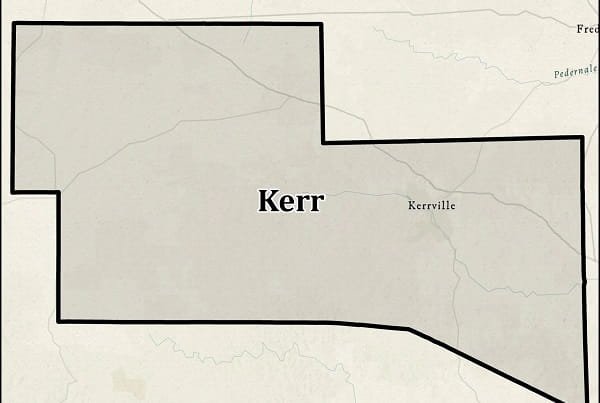
Quick Overview of Kerr County
| Category | Details |
| State | Texas |
| Region | Texas Hill Country |
| County seat | Kerrville |
| Established | 1856 |
| Estimated population | 54,037 in 2025 |
| Land area | Approximately 1,109 square miles |
| Incorporated cities | Kerrville and Ingram |
| Governing body | County judge and four-member Commissioners’ Court |
| County judge | Rob Kelly |
| Commissioners’ Court administrator | Jody Grinstead |
| County manager | None |
| Main trial courts | 198th and 216th District Courts |
| County Court at Law judge | Susan F. Harris |
| Sheriff | Larry L. Leitha Jr. |
| County attorney | Heather Stebbins |
| County clerk | Nadene Alford |
| District clerk | Eunavae Baublit Tonroy |
| Regional airport | Kerrville–Kerr County Airport |
| Major economic sectors | Healthcare, tourism, retail, education, construction, ranching and public services |
Kerr County had an estimated population of 54,037 in July 2025, representing growth of approximately 2.7% from the April 2020 population base. It contained 26,586 housing units in 2025 and 22,615 households during the 2020–2024 reporting period.
Location and Geographic Structure
Kerr County lies approximately 65 miles northwest of San Antonio in the central Texas Hill Country. Kimble County is to the north, Gillespie County lies to the northeast, Kendall County is to the east, Bandera County is to the south, Real County is to the southwest and Edwards County is to the west.
The landscape includes limestone hills, river valleys, ranchland, cedar-covered slopes, streams and wooded residential areas. The Guadalupe River enters western Kerr County near Hunt and flows through Ingram, Kerrville and Center Point before continuing towards Kendall County.
Important geographic areas include:
- Upper Guadalupe River communities
- Kerrville and its urban neighbourhoods
- Ingram and West Kerr County
- Center Point and eastern Kerr County
- Mountain Home and northwestern ranchland
- Camp Verde and southern rural communities
- River camps and retreat centres
- Large private ranches and wildlife properties
Interstate 10 is the county’s principal regional highway and provides connections towards San Antonio, Junction, El Paso and other parts of Texas. State Highway 16 connects Kerrville with Fredericksburg and Bandera, while State Highways 27, 39 and 41 serve Ingram, Hunt, Center Point and rural western areas. Kerr County is officially described as covering approximately 1,109 square miles.
Cities and Unincorporated Communities
Kerr County contains two incorporated municipalities:
- Kerrville
- Ingram
Kerrville has its own city council, police department, fire department, planning system, utilities and municipal services. Ingram also maintains a separate city government and provides local services within its boundaries.
Important unincorporated communities include:
- Camp Verde
- Center Point
- Divide
- Hunt
- Mountain Home
- Turtle Creek
- Reservation
- Cypress Creek
- Japonica
- Live Oak
- Tierra Linda
These communities may have recognised names, postal addresses, schools or volunteer fire departments, but they do not have independent municipal governments. Kerr County therefore provides many services involving roads, law enforcement, subdivision review, environmental health and emergency planning.
A Kerrville or Ingram mailing address does not always mean that a property is inside the city limits. Residents should confirm the jurisdiction before contacting a permitting office, reporting a road problem or requesting police assistance. The county’s official local-government directory recognises Kerrville and Ingram as its two municipal governments.
Population and Housing
Kerr County has a comparatively large retirement-age population. Approximately 32.2% of residents are aged 65 or older, while about 17.7% are under 18. Hispanic or Latino residents account for approximately 28.3% of the population, and around 7.7% of residents are foreign-born.
Important housing and income figures for 2020–2024 include:
- Owner-occupied housing rate: 70.1%
- Median owner-occupied home value: $321,200
- Median gross monthly rent: $1,109
- Median monthly owner cost with a mortgage: $1,767
- Average household size: approximately 2.3 people
- Median household income: approximately $68,000
- Per-capita income: approximately $40,000
- Residents living below the poverty line: approximately 13%
- Housing units in 2025: 26,586
Housing ranges from apartments and established Kerrville neighbourhoods to riverside homes, retirement communities, ranch properties and remote rural residences.
Limited housing supply, rising land values and demand from retirees and second-home buyers affect affordability. Rural development also creates questions involving groundwater availability, septic systems, floodplains, road access and emergency-response times.
Economy and Employment
Kerr County’s economy is based largely on healthcare, tourism, retail, education, construction, government services, ranching and small businesses. Kerrville functions as the main commercial and medical centre for a wider Hill Country area.
The county recorded 1,581 employer establishments in 2023. Retail sales reached approximately $1.31 billion in 2022. The size of Kerrville’s retail sector reflects spending by local residents, visitors and people travelling from surrounding rural counties for shopping, healthcare and professional services.
Important economic and institutional assets include:
- Peterson Health
- Kerrville Veterans Affairs Medical Center
- Kerrville State Hospital
- Schreiner University
- James Avery Artisan Jewelry
- Kerrville–Kerr County Airport
- Hill Country tourism businesses
- Summer camps and retreat centres
- Construction and property services
- Ranching and wildlife operations
- Downtown Kerrville
- Interstate 10 commercial activity
Tourism is supported by the Guadalupe River, local parks, live music, festivals, hunting, outdoor recreation, summer camps and Hill Country scenery. Healthcare is especially important because Kerrville serves both the local population and residents of surrounding counties.
Agriculture is less intensive than in flatter Texas regions, but cattle ranching, livestock, wildlife management, hay production and rural land services remain economically and culturally important.
County Administration and Government
Kerr County is governed by a Commissioners’ Court consisting of the county judge and four commissioners. Each commissioner represents one geographic precinct, while the county judge is elected countywide.
The current Commissioners’ Court members are:
- County judge: Rob Kelly
- Precinct 1 commissioner: Tom Jones
- Precinct 2 commissioner: Richard “Rich” Paces
- Precinct 3 commissioner: Jeff Holt
- Precinct 4 commissioner: Don Harris
The Commissioners’ Court is responsible for county budgets, property-tax rates, contracts, road funding, facilities and appointments of most non-elected department heads. It also approves subdivision rules, manages county property and coordinates public programmes.
The county judge presides over Commissioners’ Court and serves as the county’s principal spokesperson and ceremonial head. The title should not be confused with the judges who preside over the 198th District Court, 216th District Court and County Court at Law.
Administrative Leadership
Kerr County does not operate under a conventional county-manager or county-administrator system. Administrative authority is divided among Commissioners’ Court, elected officials and appointed department heads.
Jody Grinstead serves as Commissioners’ Court administrator. Her office supports meetings, agendas, records, correspondence and administrative coordination for the county judge and commissioners. She is not a county manager with general authority over every elected office.
The Commissioners’ Court appoints and monitors many department heads. However, independently elected officials—including the sheriff, county attorney, county clerk, treasurer and tax assessor-collector—exercise powers granted directly by Texas law.
Major administrative areas include:
- Budget and financial planning
- Human resources
- Facilities
- Road and bridge operations
- Emergency management
- Environmental health
- Information technology
- Veterans’ services
- Animal control
- Indigent services
- Public records
Other Important County Officials
Current elected and appointed office-holders include:
- Sheriff: Larry L. Leitha Jr.
- County attorney: Heather Stebbins
- County treasurer: Tracy Soldan
- Tax assessor-collector: Bob Reeves
- County clerk: Nadene Alford
- District clerk: Eunavae Baublit Tonroy
- 198th Judicial District attorney: Stephen Harpold
- 216th Judicial District attorney: Lucy Wilke
Sheriff Larry Leitha leads county law enforcement, detention, civil-process and court-security operations. The Sheriff’s Office generally provides patrol services outside Kerrville and Ingram, which operate their own police departments.
County Attorney Heather Stebbins prosecutes qualifying misdemeanour cases in County Court at Law and provides civil legal advice to county government. District Attorneys Stephen Harpold and Lucy Wilke prosecute felony cases within their respective judicial districts.
Nadene Alford maintains county-level court records, Commissioners’ Court documents, land records and vital statistics. Eunavae Baublit Tonroy was appointed to complete the district clerk’s unexpired term beginning in April 2026 after Dawn Lantz retired.
Judiciary and Court System
Kerr County is served by two state district courts:
- 198th District Court: Judge M. Patrick Maguire
- 216th District Court: Judge Albert “Pat” D. Pattillo III
The district courts handle:
- Felony criminal cases
- Major civil disputes
- Divorce and family-law cases
- Child-custody proceedings
- Property-title disputes
- Certain juvenile matters
- Other cases assigned under Texas law
The 198th Judicial District includes Kerr and Bandera counties. The 216th Judicial District serves Kerr, Gillespie and Kendall counties. Each district has its own elected district attorney.
Judge Susan F. Harris presides over Kerr County Court at Law. Its jurisdiction includes Class A and Class B misdemeanours, family-law cases, civil disputes within its statutory limit, probate, guardianship, juvenile matters and appeals from justice and municipal courts.
Kerr County also has four justice-of-the-peace courts. They handle lower-level civil disputes, evictions, traffic matters, certain misdemeanours, warrants and preliminary proceedings. Municipal courts in Kerrville and Ingram hear ordinance violations and qualifying cases arising within their cities.
Public Safety and Emergency Services
The Kerr County Sheriff’s Office is the principal law-enforcement agency for unincorporated communities. Kerrville and Ingram maintain municipal police departments.
Fire and emergency services are provided through a combination of municipal and volunteer organisations, including:
- Kerrville Fire Department
- Ingram Volunteer Fire Department
- Center Point Volunteer Fire Department
- Hunt Volunteer Fire Department
- Mountain Home Volunteer Fire Department
- Divide Volunteer Fire Department
- Upper Turtle Creek Volunteer Fire Department
- Other local emergency-service organisations
Flooding is one of Kerr County’s most serious natural hazards. The county also plans for wildfires, severe thunderstorms, extreme heat, winter weather, drought and hazardous-material incidents. Emergency Management maintains the county emergency plan, coordinates disaster responses and manages public-warning programmes such as CodeRED.
The county is also developing procedures for the Guadalupe River Flood Warning System, which combines river gauges, warning sirens, weather information and coordination among local agencies.
Infrastructure and Public Services
Kerr County Road and Bridge maintains approximately:
- 465 linear miles of roads and rights-of-way
- 18 bridges
- Several low-water crossings
- Ingram Dam
- Flatrock Park Dam
- Lion’s Park Dam
- School-zone warning systems
County-maintained roads are paved with chip-seal surfaces. Other roads are controlled by Kerrville, Ingram, the Texas Department of Transportation, private property owners or homeowners’ associations.
Other county services include:
- Subdivision and development review
- Floodplain administration
- Septic-system regulation
- Environmental health
- Animal control
- Emergency management
- Veterans’ assistance
- Elections
- Tax collection
- Property and court records
- Adult and juvenile probation
- Indigent healthcare assistance
- Public facilities
Kerr County generally does not require standard building permits or certificates of occupancy for construction in unincorporated areas. However, floodplain permits, driveway permits, septic permits, water-well approval and subdivision compliance may still be required.
Frequently Asked Questions
Q1. What is the county seat of Kerr County?
A: Kerrville is the county seat. The historic Kerr County Courthouse is located at 700 Main Street.
As of late July 2026, the courthouse is temporarily closed to the public because of serious flood damage. Several offices and court functions have been moved to temporary locations, so residents should confirm the current address before visiting.
Q2. Are Kerrville and Kerr County the same government?
A: No. Kerrville is an incorporated city with its own council, police department, fire department and municipal services. Kerr County is a separate government serving Kerrville, Ingram and all unincorporated communities.
Q3. Does Kerr County have a county manager?
A: No. Kerr County is governed administratively through Commissioners’ Court, elected officials and appointed department heads. Jody Grinstead is the Commissioners’ Court administrator, not a county manager.
Q4. Who issues building permits in unincorporated Kerr County?
A: Kerr County generally does not issue conventional building permits or certificates of occupancy. However, permits may be necessary for floodplain work, driveways, septic systems, water wells and certain subdivision activities.
Q5. Which court handles major criminal cases?
A: The 198th and 216th District Courts handle felony criminal cases. Kerr County Court at Law handles Class A and Class B misdemeanours, along with family, probate, juvenile and qualifying civil matters.