 By Patricia Jones
 Travis County is the principal administrative, political and economic centre of Central Texas. It contains Austin, the capital of Texas, together with rapidly growing suburbs, technology districts, rural communities, lakes, parks and large unincorporated areas.
Austin is the county seat and contains most major county offices, courts and correctional facilities. Other important communities include Pflugerville, Manor, Lakeway, Bee Cave, Lago Vista, West Lake Hills and parts of Cedar Park, Leander, Round Rock and Elgin.
Travis County government is separate from the City of Austin. It manages courts, criminal prosecution, the county jail, elections, property-tax administration, roads in unincorporated areas, emergency services, parks, social programmes and environmental services for approximately 1.39 million residents.
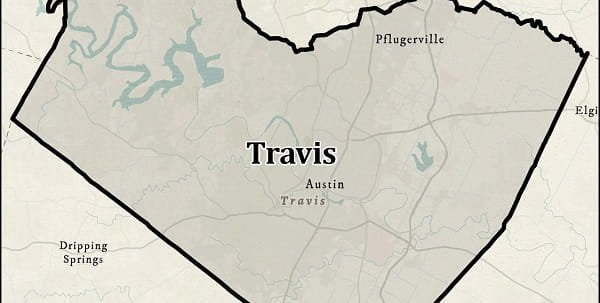
Quick Overview of Travis County
| Category | Details |
| State | Texas |
| Region | Central Texas |
| Metropolitan area | Austin–Round Rock–San Marcos |
| County seat | Austin |
| Established | 1840 |
| Estimated population | 1,389,670 in 2025 |
| Land area | Approximately 990 square miles |
| Municipal jurisdictions | 22 cities and villages wholly or partly within the county |
| Governing body | Five-member Commissioners Court |
| County Judge | Andy Brown |
| Precinct 1 Commissioner | Jeffrey W. Travillion Sr. |
| Precinct 2 Commissioner | Brigid Shea |
| Precinct 3 Commissioner | Ann Howard |
| Precinct 4 Commissioner | George Morales III |
| Administrative structure | County Judge and several divisional County Executives |
| Sheriff | Sally Hernandez |
| District Attorney | José Garza |
| County Attorney | Delia Garza |
| County Clerk | Dyana Limon-Mercado |
| District Clerk | Velva Price |
| Tax Assessor-Collector | Celia Israel |
| Treasurer | Dolores Ortega Carter |
| Local Administrative District Judge | Judge Amy Clark Meachum |
| Presiding Criminal Courts Judge | Judge Cliff Brown |
| FY 2026 all-funds budget | Approximately $2.16 billion |
| Major industries | Technology, government, healthcare, education, semiconductors and professional services |
Travis County’s population increased by approximately 7.7% between the April 2020 population base and July 2025. The county had an estimated 682,547 housing units in 2025.
Location and Geographic Structure
Travis County is located in Central Texas along the Interstate 35 corridor. Williamson County borders it to the north, Bastrop County lies to the east, Caldwell and Hays counties are to the south, and Blanco and Burnet counties are located to the west.
Its geography includes:
- The urban centre of Austin
- Fast-growing suburban communities
- Texas Hill Country landscapes
- Rural eastern communities
- Lake Travis and Lake Austin
- Colorado River corridors
- Agricultural land
- Environmental preserves
- Floodplains and watersheds
- Large unincorporated areas
Major transport routes include:
- Interstate 35
- State Highway 130
- S. Highway 183
- S. Highway 290
- State Highway 71
- State Highway 45
- Loop 1 or MoPac Expressway
- Loop 360
- Ranch Road 620
- FM 969
- FM 973
Western Travis County contains hills, lakes and environmentally sensitive areas. Eastern Travis County has flatter land and continues to attract residential, industrial, logistics and semiconductor-related development.
Cities, Villages and Unincorporated Areas
Austin is the largest municipality and contains most of the county’s population. However, several other cities and villages lie wholly or partly within Travis County.
These include:
- Austin
- Bee Cave
- Briarcliff
- Cedar Park
- Creedmoor
- Elgin
- Jonestown
- Lago Vista
- Lakeway
- Leander
- Manor
- Mustang Ridge
- Pflugerville
- Point Venture
- Rollingwood
- Round Rock
- San Leanna
- Sunset Valley
- The Hills
- Volente
- Webberville
- West Lake Hills
Some municipalities cross county boundaries. Cedar Park and Leander extend mainly into Williamson County, while Elgin extends into Bastrop County. Mustang Ridge extends into Caldwell County, and Round Rock is primarily in Williamson County.
Cities normally control municipal zoning, police, fire protection, neighbourhood streets, building permits and local parks. Travis County has a larger direct role outside city boundaries.
Important unincorporated communities and areas include:
- Del Valle
- Wells Branch
- Hornsby Bend
- Garfield
- Hudson Bend
- Onion Creek-area communities
- River Place-area sections
- Southeast Travis County settlements
- Rural communities east of Manor
- Communities around Lake Travis
County Development Services oversees subdivision review, floodplain requirements, construction inspections and permits outside incorporated city limits. Texas counties have more limited zoning powers than cities.
Population and Housing
Travis County is one of the most diverse and rapidly changing counties in Texas.
Important population figures include:
- Residents under 18: 19.7%
- Residents aged 65 or older: 11.6%
- Hispanic or Latino population: 33.9%
- Black population: 9%
- Asian population: 10.2%
- Foreign-born residents: 18.1%
- Veterans: Approximately 46,700
- Residents speaking another language at home: 30%
- Average household size: 2.23 people
Important housing figures include:
- Housing units in 2025: 682,547
- Owner-occupied housing rate: 52.1%
- Median owner-occupied home value: $523,000
- Median gross monthly rent: $1,744
- Households during 2020–2024: 583,747
- Residential building permits in 2025: 15,059
Housing costs differ considerably across the county. Central and western Austin generally have higher property values, while eastern and southeastern areas have historically provided more moderately priced housing. Rapid development is changing those patterns.
County housing responsibilities include affordable-housing investment, homelessness programmes, community development and support for qualifying low- and moderate-income households.
Education, Income and Workforce
Travis County has a highly educated workforce connected with technology, government, research, healthcare and professional services.
Approximately:
- 9% of residents aged 25 and older have completed high school.
- 6% hold a bachelor’s degree or higher.
- 2% of residents aged 16 and older participate in the civilian labour force.
- Median household income was $99,611 during 2020–2024.
- Per-capita income was $62,607.
- Around 10.5% of residents lived below the poverty line.
Important educational institutions include:
- The University of Texas at Austin
- Austin Community College
- Huston-Tillotson University
- Edward’s University
- Concordia University Texas
- Austin Independent School District
- Pflugerville Independent School District
- Lake Travis Independent School District
- Manor Independent School District
- Del Valle Independent School District
School districts, colleges and universities are separate organisations. They are not departments controlled by Travis County Commissioners Court.
Economy and Employment
Travis County has a large and diverse economy centred on Austin and the surrounding technology region.
Major economic sectors include:
- Software and information technology
- Semiconductor production and design
- State government
- Higher education
- Healthcare
- Professional and technical services
- Construction
- Finance
- Tourism and hospitality
- Creative industries
- Manufacturing
- Logistics
- Retail
The county had approximately 42,837 employer establishments and more than 736,000 jobs in 2023. Total annual payroll exceeded $63.5 billion.
Downtown Austin, North Austin, the Domain, East Austin, Pflugerville, Del Valle and the State Highway 130 corridor are important employment areas.
The eastern county has attracted major industrial and technology investment because of available land and access to the airport, State Highway 130 and regional transport routes. However, growth also creates pressure involving roads, water, housing, flood protection and emergency services.
Commissioners Court
Travis County is governed by a five-member Commissioners Court consisting of the County Judge and four precinct commissioners.
The current members are:
- County Judge: Andy Brown
- Precinct 1: Jeffrey W. Travillion Sr.
- Precinct 2: Brigid Shea
- Precinct 3: Ann Howard
- Precinct 4: George Morales III
The Commissioners Court is not an ordinary trial court. It is the county’s principal policy-making, financial and administrative body.
Its responsibilities include:
- Adopting the county budget
- Setting the county property-tax rate
- Approving contracts
- Managing county property
- Funding courts and corrections
- Supporting public safety
- Approving road and park projects
- Establishing personnel policies
- Creating administrative programmes
- Appointing certain department leaders
- Managing economic-development initiatives
- Supporting health and human services
The Commissioners Court normally meets at 700 Lavaca Street in Austin.
County Judge and Administrative Structure
Andy Brown serves as Travis County Judge. The County Judge presides over Commissioners Court, performs major administrative functions and serves as the county’s director of emergency management.
Travis County does not use one conventional county administrator or county manager who directly supervises every department. Instead, its organisation combines the County Judge, Commissioners Court, independently elected officials and several professional County Executives responsible for major service divisions.
Current divisional leadership includes:
- Community Legal Services: Geoff Burkhart
- Innovative Justice and Program Analysis: Jacqueline Van Wormer
- Emergency Services: Charles Brotherton
- Health and Human Services: Pilar Sanchez
- Transportation and Natural Resources: Cynthia McDonald
- Planning and Budget: Jessica Rio
- Technology and Operations: Maurice McCreary
These executives coordinate departments and programmes within their assigned service areas. They help prepare budgets, supervise administrative operations, implement Commissioners Court policies and monitor major projects.
They do not control independently elected offices such as the Sheriff, District Attorney, County Clerk or Tax Assessor-Collector.
County Budget
Travis County’s adopted FY 2026 all-funds budget totals approximately $2.16 billion.
The main budget components are:
- General Fund: Approximately $1.56 billion
- Other funds: Approximately $599.4 million
Major General Fund allocations include:
- General government
- Justice system
- Corrections and rehabilitation
- Public safety
- Health and human services
- Infrastructure and environmental services
- Community and economic development
- Transfers and debt service
The justice system, corrections, Sheriff’s Office, emergency services and courts represent a substantial share of county spending.
Other Important County Officials
Several Travis County offices are led by independently elected officials.
Current officeholders include:
- District Attorney: José Garza
- County Attorney: Delia Garza
- Sheriff: Sally Hernandez
- County Clerk: Dyana Limon-Mercado
- District Clerk: Velva Price
- Tax Assessor-Collector: Celia Israel
- County Treasurer: Dolores Ortega Carter
Their duties differ significantly.
The District Attorney prosecutes most felony criminal cases. The County Attorney prosecutes misdemeanours and represents county government in many civil matters.
The County Clerk maintains Commissioners Court records, official public records and files for county courts at law. The District Clerk maintains records for district courts.
The Tax Assessor-Collector handles vehicle registration, voter-registration functions assigned to the office and county tax collection. The Treasurer manages county funds and banking responsibilities.
Judiciary and Court System
Travis County has a large judicial system consisting of district courts, county courts at law, probate courts and Justice of the Peace courts.
District Courts
The district-court system includes separate civil and criminal courts.
Judge Amy Clark Meachum of the 201st District Court serves as the Travis County Local Administrative District Judge. Her current term runs from September 2025 through August 2027.
The Local Administrative District Judge coordinates matters involving:
- Court administration
- Judicial assignments
- Court facilities
- Administrative policies
- Coordination among district judges
- Relations with county departments
Judge Cliff Brown of the 147th District Court serves as Presiding Judge for the Travis County Criminal Courts.
District courts handle:
- Felony criminal cases
- Major civil lawsuits
- Divorce and family cases
- Child-protection matters
- Land disputes
- Election cases
- Other matters assigned under Texas law
County Courts at Law
Travis County has civil and criminal county courts at law.
These courts generally handle:
- Misdemeanours
- Civil claims within legal limits
- Appeals from Justice Courts
- Selected family matters
- Criminal traffic cases
- Other statutory matters
Probate Courts
The county has two statutory probate courts:
- Probate Court No. 1: Judge Guy Herman
- Probate Court No. 2: Judge Nicholas Chu
They handle estates, wills, guardianships, trusts and certain mental-health proceedings.
Justice of the Peace Courts
Travis County has five Justice of the Peace precincts:
- Precinct 1: Yvonne Williams
- Precinct 2: Randall Slagle
- Precinct 3: Sylvia Holmes
- Precinct 4: Raúl González
- Precinct 5: Tanisa Jeffers
These courts handle small claims, evictions, Class C misdemeanours, traffic matters, warrants and other lower-level cases.
Public Safety and Corrections
The Travis County Sheriff’s Office provides law-enforcement services in unincorporated areas and operates county correctional facilities.
Its responsibilities include:
- Patrol
- Criminal investigations
- County jail operations
- Prisoner transport
- Court security
- Civil-process support
- Emergency response
- Specialised law-enforcement units
Austin and other incorporated cities normally operate their own police departments.
Five elected constables also serve Travis County. Their work includes civil-process service, warrants, court security and law-enforcement duties connected with Justice Courts.
Fire protection in unincorporated areas is usually provided by emergency-services districts and local fire departments. The County Fire Marshal handles fire investigations, inspections and prevention responsibilities within its jurisdiction.
STAR Flight provides medical transport, rescue and emergency aviation services.
Health and Community Services
Travis County Health and Human Services manages or supports programmes involving:
- Family assistance
- Workforce development
- Veterans services
- Housing programmes
- Community development
- Public-health partnerships
- Child and family services
- Food assistance
- Re-entry services
- Social-service contracts
Central Health is a separate hospital district responsible for healthcare access for qualifying low-income residents. Austin Public Health also provides public-health services through local and intergovernmental arrangements.
Roads, Parks and Environmental Services
Transportation and Natural Resources manages county infrastructure and environmental programmes.
Its responsibilities include:
- County roads
- Bridges
- Drainage projects
- Road construction
- Traffic engineering
- Fleet services
- Surveying
- Subdivision review
- Floodplain management
- Development permits
- Parks
- Conservation land
- Environmental-quality programmes
Travis County operates numerous regional parks and preserves, including Pace Bend Park, Reimers Ranch Park, East Metropolitan Park and Hamilton Pool Preserve.
Roads inside cities are normally maintained by municipal governments. State highways are managed by the Texas Department of Transportation.
Frequently Asked Questions
Q1. Is Travis County the same government as the City of Austin?
A: No. Austin has its own mayor, council, police, fire and municipal departments. Travis County is a separate government responsible for courts, the county jail, elections, property administration and services in unincorporated areas.
Q2. Does Travis County have a county administrator?
A: Not in the conventional single-manager form. County Judge Andy Brown acts as a chief administrator, while several appointed County Executives manage major service divisions under Commissioners Court.
Q3. What is the difference between the District Attorney and County Attorney?
A: The District Attorney primarily prosecutes felony cases. The County Attorney prosecutes misdemeanours and provides civil legal services to county government.
Q4. Which office keeps Travis County court and property records?
A: The District Clerk keeps district-court records. The County Clerk keeps county-court and official public records, including many property documents.
Q5. Which agency provides police services in unincorporated Travis County?
A: The Travis County Sheriff’s Office is the principal law-enforcement agency outside incorporated cities. Municipal police departments generally serve residents inside city boundaries.