 By Patricia Jones
 Marin County lies immediately north of San Francisco and combines compact cities, affluent suburbs, coastal villages, protected open space, ranchland and large areas of public parkland. San Rafael is the county seat and the main centre for county administration, courts, healthcare and business.
The county is known for the Marin Headlands, Mount Tamalpais, Point Reyes and the Frank Lloyd Wright-designed Marin County Civic Center. Major challenges include housing costs, wildfire risk, sea-level rise and access to services in remote West Marin.
Quick Overview of Marin County
| Category | Details |
| State | California |
| Region | North Bay area of the San Francisco Bay Area |
| County seat | San Rafael |
| Established | 1850 |
| Estimated population | 253,694 in 2025 |
| Land area | Approximately 520 square miles |
| Incorporated cities and towns | 11 |
| Governing body | Five-member Board of Supervisors |
| Board president | Eric Lucan |
| County executive | Derek Johnson |
| Sheriff-Coroner | Jamie Scardina |
| District attorney | Lori E. Frugoli |
| Assessor-Recorder-County Clerk | Shelly Scott |
| Director of finance | Mina Martinovich |
| Main trial court | Superior Court of California, County of Marin |
| Presiding judge | Stephen P. Freccero |
| Court executive officer | James M. Kim |
| Major sectors | Healthcare, professional services, retail, tourism, construction, education, government and agriculture |
The county’s 2025 population estimate was 253,694, about 3.3% below the April 2020 estimate base. Marin nevertheless remains one of California’s highest-income counties, with a 2020–2024 median household income of about $149,091.
Location, Cities and Communities
Marin County is bordered by Sonoma County to the north, San Francisco Bay to the east, the Golden Gate and San Francisco to the south, and the Pacific Ocean to the west. Its landscape includes bay shorelines, wooded ridges, wetlands, dairy ranches, redwood groves and coastal headlands.
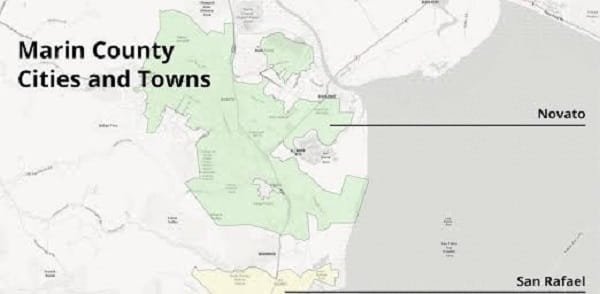
The 11 incorporated municipalities are Belvedere, Corte Madera, Fairfax, Larkspur, Mill Valley, Novato, Ross, San Anselmo, San Rafael, Sausalito and Tiburon. Important unincorporated communities include Bolinas, Dillon Beach, Inverness, Kentfield, Marin City, Marinwood, Nicasio, Point Reyes Station, Strawberry and Tamalpais Valley.
Cities and towns generally handle planning, permits, local streets and municipal services. The County performs those functions in unincorporated areas. Because postal addresses do not always identify jurisdiction, property owners should confirm municipal boundaries before seeking permits or reporting road problems.
Population, Housing and Economy
Marin has an older and highly educated population. About 25.7% of residents are aged 65 or older and 18.3% are under 18. Approximately 61.1% of adults hold a bachelor’s degree or higher. Hispanic or Latino residents form about one-fifth of the population, and 19.6% of residents are foreign-born.
Housing is a major public issue. The 2020–2024 median value of an owner-occupied home was about $1.51 million, and median gross rent was approximately $2,668. Limited land, environmental protections, difficult terrain and strong regional demand affect supply. County and municipal planning therefore focuses on affordable housing, homelessness, workforce retention and development near transport corridors.
The economy is led by healthcare, professional and technical services, retail, tourism, construction, education, government and small businesses. Marin recorded 10,049 employer establishments and 106,249 jobs in 2023. Agriculture remains important in West Marin, especially dairy, livestock and value-added food production, while coastal recreation and protected landscapes support hospitality and visitor spending.
County Government and Administration
The five-member Board of Supervisors is Marin County’s legislative and executive governing body. The current members are Mary Sackett in District 1, Brian Colbert in District 2, Stephanie Moulton-Peters in District 3, Dennis Rodoni in District 4 and Eric Lucan in District 5. Lucan serves as Board President for 2026, Moulton-Peters as First Vice President and Colbert as Second Vice President.
The Board adopts ordinances, approves the budget, sets policy and governs several special districts. Its responsibilities include health and social services, unincorporated roads, land use, public safety funding, parks, open space and regional programmes.
Derek Johnson serves as County Executive and is the chief appointed administrative officer. His office implements Board policy, prepares the budget, coordinates departments and manages countywide priorities. Marin has recently reorganised departments into functional groups led by assistant county executives to improve coordination across infrastructure, community services, health, justice and welfare programmes.
Important County Officials
Sheriff-Coroner Jamie Scardina leads patrol services in unincorporated areas, the county jail, court security, emergency communications, civil process and death investigations. District Attorney Lori E. Frugoli prosecutes violations of state law and manages victim, consumer-protection and crime-prevention programmes.
Shelly Scott serves as Assessor-Recorder-County Clerk. Her combined office values taxable property, records deeds and other land documents, maintains vital records and issues marriage licences. Director of Finance Mina Martinovich oversees the county’s auditor, controller, treasurer, tax collector and public administrator functions.
Judiciary and Court System
The Superior Court of California, County of Marin is the county’s principal trial court. Judge Stephen P. Freccero serves as Presiding Judge, while James M. Kim is Court Executive Officer, Clerk of the Court and Jury Commissioner. The court is part of California’s independent judicial branch rather than a department controlled by the Board of Supervisors.
The Superior Court handles felony and misdemeanour criminal cases, traffic matters, civil disputes, family law, probate, juvenile proceedings, small claims and restraining orders. Most services are based at the Marin County Civic Center in San Rafael, with juvenile functions also conducted at the county’s juvenile facility.
Public Safety, Transport and County Services
Police and fire responsibility depends on location. Incorporated cities may operate their own departments or receive service through regional agencies, while the Sheriff’s Office serves unincorporated communities and performs countywide functions. Emergency planners prepare for wildfires, earthquakes, floods, landslides, severe storms and coastal hazards.
U.S. Highway 101 is the main north-south route, while State Routes 1 and 37 connect coastal and bay communities. SMART provides passenger rail through eastern Marin, Marin Transit operates local buses, and ferry services link Larkspur, Sausalito and Tiburon with San Francisco. Marin County Airport at Gnoss Field supports general aviation.
County services include health and social programmes, elections, libraries, parks, open space, unincorporated planning, environmental health, veterans services and roads. Public Works maintains more than 420 miles of county roads; cities, Caltrans, park agencies and private owners manage other routes.
Frequently Asked Questions
Q1. Are San Rafael and Marin County the same government?
A: No. San Rafael is an incorporated city with its own council and municipal departments. Marin County is a separate government serving the entire county and directly providing local services in unincorporated communities.
Q2. Who issues a building permit in Marin County?
A: The relevant city or town normally issues permits inside its boundaries. Marin County Community Development Agency handles building and planning matters in unincorporated areas.
Q3. Where are deeds and marriage records kept?
A: The Assessor-Recorder-County Clerk records deeds and maintains many official property and vital records. The same combined office also processes marriage licences and civil ceremonies.
Q4. Which court handles criminal, family and probate cases?
A: Marin County Superior Court handles these state trial-level matters. Municipal governments do not operate separate city courts for major criminal, family or probate cases.
Q5. How can a resident identify who maintains a road?
A: First confirm whether the road is a city street, county-maintained road, state highway, park road or private road. The responsible agency changes with the road’s jurisdiction.